
By Elizabeth Henderson
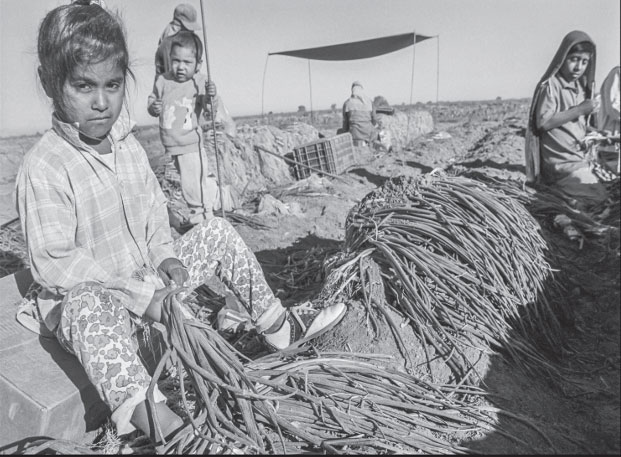
Honorina Ruis, 6 years old, ties bunches of green onions together in a field just south of the US border farmed by Muranda Farms. Her mother, Esperanza Ruis, and her brothers, Rigoberto 12, and Juan Antonion, 3, work with her. Image by David Bacon, featured in his new book More than a Wall, printed with permission.
If you were planning to make your farm the “employer of choice,” would you start by reducing hourly wages and adding a charge for previously free housing? This is what House Ag Committee chair G.T. Thompson’s Securing Agriculture’s Workforce Act (SAWA) proposes as the solution to labor shortages made acute by ICE raids. This bill contains the Big Ag wish list, a lot like the Farm Workforce Modernization Act (FWMA) that, thanks to concerted opposition, did not pass in 2021 or again in 2025. Those of us who care about fairness in farming need to look sharp or Big Ag’s flunkies will slip it through in a “must pass” defense bill.
H2A Expansion
For mainstream agriculture, SAWA marks the culmination of the shift from resident farmworkers to H2A guestworkers that has been underway for almost a decade. In 2025 growers recruited 398,258 H-2A workers (a sixth of the country’s farm labor workforce), mostly from Mexico, under temporary work contracts. These laborers can only work for the grower, grower association, or farm labor contractor that recruits them, and can be fired and deported for protesting, organizing or because the manager thinks they are working too slowly. Half of the H2A certifications are in five states – Florida, Georgia, California, Washington and North Carolina. Labor Consultants International, that does the complex paperwork for H2A applications for a fee, has a history of the H2A program on its website. https://www.laborci.com/blog/history-of-the-h-2-program
Towards the end of the Biden administration in April 24, Julie Su, Biden’s Secretary of Labor, and well-meaning staffers put forward the Farmworker Protection Rule, a revised Rule for the H2A program that attempted to redress some of the worst abuses that complaints or investigative reporting had revealed. The Rule allowed H2A workers to freely receive visitors in farm-provided housing, including union representatives, required seat belts in all vehicles transporting H2A workers, opened the possibility of unionization for H2A workers, and clarified requirements for the work orders that specify wages and work assignments. Biden’s DOL also implemented the Farm Labor Stabilization Act, $50 million in grants to farms to pay for improvements to housing and wage hikes if the farms hired H2A workers from Guatemala, Honduras and El Salvador. Paused along with many other agricultural program funding in early 2025, farms report receiving promised funds for this one.
At the end of June, 2025, DOL scrapped the Farmworker Protection Rule. With its elimination, growers are free to bar outsiders (community groups or unions) from labor camps, give workers contracts in languages they can’t read, retaliate against workers who complain of bad conditions, and even stop using seat belts in the vehicles transporting laborers to the fields.
Greeted by overwhelming support from big ag, the current administration has promised to make H2A even more grower-friendly. The secretary of agriculture, Brooke Rollins, told Congress that she’d modernize the H-2A program “to do everything we can to make sure that none of these farms or dairy producers are put out of business [by immigration enforcement].”
Effective October 2, 2025, DOL implemented a new rule that lowers H2A wages by changing the way the Adverse Effect Wage Rate (AEWR, that is supposed to prevent H2A from undercutting domestic farmworker wages) is calculated. The result is a reduction in wages from $3 to $7 an hour depending on the state, and allows farmers to charge an “Adverse Compensation Adjustment,” code-speak for weekly payments for housing. The rule sets up two skill-based tiers for wages. If employers would have hired an untrained person for a job, they can pay the lower rate, even though the person they actually hire has years of experience. See “Trump’s new H-2A wage rule will radically cut the wages of all farmworkers,” from the Economic Policy Institute for the full details on how the AEWR is calculated and the effects of this new rule.
In November, 2025, he UFW Foundation and 18 individual farmworkers sued to stop these wage cuts. In May, 2026, a federal district court denied their request for a preliminary injunction to stop the cuts, so they will continue while the case works its way through the courts. The suit argues that the wage cut rule violates the federal statute that requires that H2A not have an adverse effect on the jobs and wages of local workers. The UFW claims that the wage cut transfers over $4 billion dollars a year in wages from workers to employers. Community to Community Development, a grassroots farmworker advocacy organization in Bellingham, WA, has a series of blogs and reports that demonstrate how the increase in H2A workers has replaced local workers and lowered wages for berry pickers and tulip bulb workers.
For over 20 years, the Farm Labor Organizing Committee (FLOC) has engaged in cross-border organizing, successfully unionizing H2A workers on over 600 farms in North Carolina, despite constant attacks from the Right to Work Foundation. FLOC conducted a successful campaign against Campbell Soup’s captive supply contracts with the farms that resulted in higher payments to the farms with guaranteed passthrough to FLOC’s farmworker members. Until recently UFW has focused its organizing on resident workers in California, though it includes H2A workers in union contracts in NYS.
Keep in mind that over half the H2A visas are held, not by individual farmers, but by Farm Labor Contractors who have been found guilty of the worst abuses including wage theft, miserable housing, and even human trafficking. In calculating the new lower wage, DOL used the average payments by Farm Labor Contractors, leaving out individual farms which tend to pay more. DOL then claimed that this new rule will save employers over $24 billion over the next decade, in effect confirming the UFW claim. Not surprisingly, farm employers and the Farm Bureau crowed with delight.
Codifying the Wage Cuts into Law
In June, 2026, G. T. Thompson, Republican chair of the House Ag Committee submitted Securing Agriculture’s Workforce Act (SAWA), claiming that this bill will correct the problems for agriculture that the current administration policies on immigration have caused. But the bill goes much farther by codifying in law the October 2025 DOL Rule that lowered the wages for H2A workers. SAWA keeps Sec. Rollins’ promise to expand H2A by including meat and sea food processing workers as well as farmworkers in the H2A category, expanding contracts from a maximum of 10 months to 3 years, allowing staggered entry of workers to fit a farmer’s schedule, permitting workers to shift from one certified farm or Farm Labor Contractor to another, and streamlining into one on-line platform the whole application process that has taken up to 3 months involving contacts with five different government agencies. To further consolidate and rationalize the system, SAWA charges the Secretary of Labor with creating an on-line registry of farm jobs and database of all H2A jobs.
While the UFW took part in negotiations that resulted in the FWMA, no farmworkers had any say in SAWA. Thompson designed this bill to cater to agribusiness, part of the administration’s campaign to retain farmer votes for Republicans. Flawed though the proposed process was, FWMA provided a path to legal status for farmworker families along with farmworkers. SAWA does not throw farmworkers even these meagre scraps. It does provide a way for farmworkers who have been working without full legal status to qualify as H2A workers without leaving the country, but to qualify for a waiver of deportation, current farmworkers not only have to document with the help of their employer that they worked 5.75 hours a day for 180 days over 2 years, they must also never have accessed any public benefits or have any record of other crimes besides working illegally. There is no mention of the fate of other members of farmworker families. Upon termination, H2A workers have 30 days to leave the country, reduced from the previous 60-day limit. Presumably this applies equally to farmworkers who went through the SAWA H2A process to save themselves from deportation even though they may have lived in this country for decades
Here is more of the Big Ag wish list that SAWA services:
*Employers who previously employed undocumented workers are off the hook for the felony charge this would currently entail.
*Even if there is a government shut-down, DOL will process H2A applications to keep the workers coming.
*Two tiers for wages allows employers to hire someone with years of experience if the job is labeled entry level and pay the lower wage.
*Calculating the Adverse Effect Wage Rate from the average of what Farm Labor Contractors pay effectively lowers the wage rate for all farmworkers.
*Strict parameters prevent the wage rate from going more than 1.5% lower or 3.25% higher than the previous year.
*Employers can charge for housing with the Secretary of Labor setting the maximum daily charge according to a SAWA formula.
*Employers can continue the fiction that H2A workers are not taking jobs from US residents by publicly posting the job listings.
*Employer certification to hire H2A is renewable and may be filed by two or more employers in association or by cooperatives.
*If a group is the “permitted filer” and is barred from certification for abusing workers, the individual farms in the group can still continue in the program.
*There is no weekly minimum or maximum of work hours guaranteed to H2A workers.
*The heat plans that farms must post for workers to see are free from enforcement.
There is no question that Thompson’s bill responds to the urgent requests of mainstream agriculture. The American Farm Bureau and an assortment of 400 agriculture organizations endorse it. Like sugar, exploitation is addictive. Yet like too much sugar in your diet, stealing from the most marginalized makes US agriculture sick. How collaborative do you imagine relations will be on the farms that invite the H2A workers they have been depending on to return for a lower wage with new fees for housing? Rather than make changes that might attract US residents to farmwork, SAWA cements the exploitative working conditions, low wages and disempowerment of farmworkers that undermine the sustainability, not to mention the social justice, of agriculture in the US.
The growing movement of workers across the food chain and the many people who want healthy food must reject SAWA along with the Republican House and Senate draft Farm Bills.
Please consider contacting your congressional representatives to express your visions for transforming US agriculture into a system that is agroecological and fair, and to urge them to vote against SAWA or future amended versions that codify reductions in farmworker wages along with the expansion of H2A. The National Organic Coalition website has a guide to reaching DC: https://www.nationalorganiccoalition.org/representative-1
Another agriculture is possible.
